THE EVENING INSIDER

5 Reasons People Exhausted by Their Nightly Supplement Routine Are Switching to an Eye-Level Light Solution

Why nothing you swallow has ever changed the light in your living room, and the five things that separate a genuine evening lens from the clear blue-light glasses sold for daytime screens.

You have just read how one woman worked it out.

She changed what went into her body a dozen times. She never once changed what was reaching her eyes.

The television. The reading lamp. The kitchen lights. The tablet.

Separate objects. One destination.

Her story ends at the idea. The pattern she called the Second-Daylight Effect.

This is what comes after it.

What an external lever actually looks like, and why almost every obvious answer fails.

THE DISCOVERY: The Evening Lens Built Around That Principle

It is not a supplement.

It is not a routine.

It is a pair of glasses you put on when the sun goes down and forget you are wearing.

MyEyeRelief Evening Glasses
An ordinary Tuesday evening. Telly on, lamp on, cup of tea. The only thing that changed is what reaches her eyes.

How you use them. You do not throw away your television. You do not swap every bulb in the house. You do not sit in the dark for the last hours of the day.

You put them on during your normal evening while watching your programmes, reading your books, or sitting under your usual lamps. You take them off when you go to bed.

No dose. No timing window. No bedtime laboratory.

But that raises a fair question, and it deserves a straight answer. Blue-light glasses have been sold in every chemist and airport for a decade. Why would these be any different?

Check Current Availability
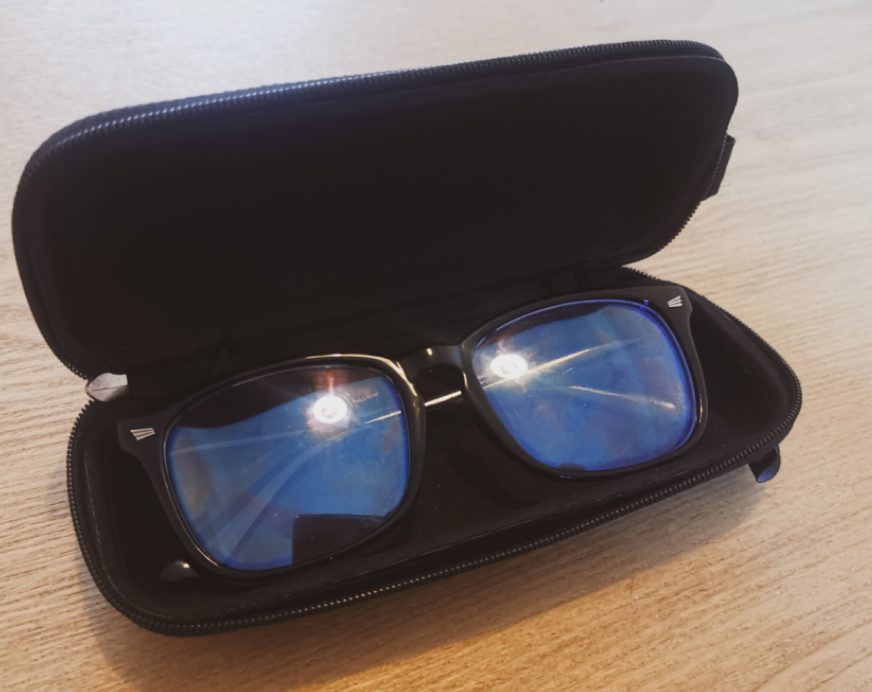
Ordinary Clear Blue-Light Glasses Are Built for a Different Job
A typical clear blue-light lens. Built for daytime screen use, so it stays almost transparent, and filters only a small fraction of the evening spectrum.

1. Ordinary Clear Blue-Light Glasses Are Built for a Different Job

Almost every pair you have seen was designed for daytime.

Office lighting. Computer work. Nine hours at a monitor.

They are built to keep colour looking normal so you can still do your job. Which means they can only ever filter a limited portion of the blue spectrum.

That is not a flaw. It is exactly what they were built for.

But it changes the question you should be asking. Not “do these block blue light?” Every pair blocks some. The useful question is:

Which wavelengths do they filter, and how much?

Trying to manage the glare of a modern evening with clear daytime lenses is like trying to stop a tidal wave with a screen door.

The Colour Is Not the Compromise. It Is the Mechanism.
The rose-magenta tint is the visible consequence of the filtering profile, not a styling choice.

2. The Colour Is Not the Compromise. It Is the Mechanism.

This is the part most people have backwards, so it is worth being blunt.

The vivid rose-magenta is not styling. It is not a brand choice. It is the visible consequence of how much light the lens is actually removing.

A lens cannot substantially alter a large portion of evening light and still look clear and unchanged. Those two things are physically at odds. Something has to give, and what gives is the colour.

So the tint is the honest signal.

A clear lens is telling you it is barely intervening. A deep rose-magenta lens is telling you it is.

If you have ever picked up a pair of blue-light glasses, looked through them, seen no difference at all, and quietly wondered whether they were doing anything, you were asking exactly the right question.

It Targets the Specific Band That Matters After Dark
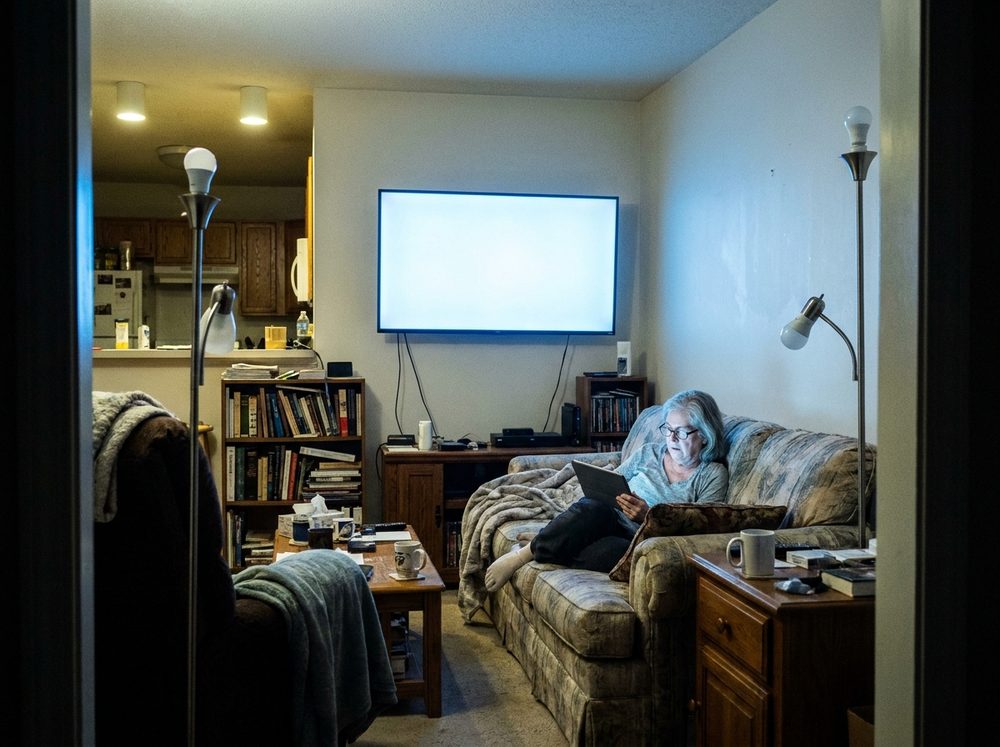
A modern living room after dark. The screens and household LEDs still putting out the short-wave evening band.

3. It Targets the Specific Band That Matters After Dark

The Measured Evening Spectrum Lens™ is built around the evening range of 400 to 500 nanometres.

Those are the short-wave spikes put out by modern televisions and bright household LEDs.

According to strict laboratory transmission testing, it does not filter a token amount of that range.

It filters 99% of the specified wavelengths across that stated band.

That distinction matters. This is not a vague reduction spread thinly across everything. It is a specified figure, across a specified range, measured under test.

The Eye-Level Principle Came From Somewhere Serious
The fighter pilot’s helmet-mounted visual system places the environmental filter directly at eye level, while keeping the cockpit displays readable.

4. The Eye-Level Principle Came From Somewhere Serious

Night-flying crews face a version of your living room, with higher stakes.

They cannot switch off their instruments. The displays have to stay readable. Managing the light entering a pilot’s eyes after dark is a critical variable for maintaining regular visual performance.

The engineering answer was never to redesign the cockpit. It was to manage selected light at eye level, right before it arrives.

That works because the eye is not only a camera. Specialised cells communicate environmental light directly to the circadian system, such as ipRGCs and melanopsin.

The eye is where light stops being illumination and becomes a signal.

Apply that same principle to an ordinary living room and the whole problem gets one centre instead of six separate battles.

It Takes Something Off the List Instead of Adding to It
The cabinet that grows one bottle at a time.

5. It Takes Something Off the List Instead of Adding to It

If the routine itself is what exhausted you, this is the reason that matters most.

Every new bottle adds another decision to your evening.

What do I take tonight. How much. Is it already too late. How will I feel tomorrow.

And when the answer disappoints, the loop simply restarts.

  • A bright evening tells your body it is still daytime
  • Winding down gets harder, so you reach for the cabinet
  • Another supplement goes in, out of frustration more than confidence
  • An uncertain night, awake at 3:00 a.m. doing arithmetic
  • A heavy morning sends you looking for a new combination

A pair of glasses does not join that loop. It removes you from it.

You put them on when the sun goes down. You take them off when you go to bed.

There is no dose to calculate. No timing window to miss. No morning to negotiate with. Nothing to stand and remember at 9:30 at night under a bright bathroom light.

It is not one more thing to manage. It is the first thing that takes something off the list.

The cost of repeating the same experiment

If supplements, sleep aids and recurring purchases add up to $100 a month, that is $600 in six months and $1,200 in one year.

And the next $100 does not recover what you already spent. It simply buys another month of approaching the same evening from the same direction.

Dr. Clara Vance, OD, FAAO

Clinical Review

Dr. Clara Vance, OD, FAAO

Board-Certified Optometric Physician · Fellow of the American Academy of Optometry

“The relationship between short-wave visible light and the circadian system is well established in modern vision and sleep science.

I reviewed the Measured Evening Spectrum Lens™ and its specified filtration profile. The lens is designed to filter 99% of the stated 400–500 nanometre band at eye level while allowing the wearer to continue using their normal television, books and room lighting.

This provides a simple, non-invasive approach to managing the evening light environment without requiring changes throughout the entire home.”

Current Batch Availability Notice
MyEyeRelief Evening Glasses

Produced in controlled laboratory batches

MyEyeRelief Evening Glasses

Measured Evening Spectrum lenses are produced in controlled, precise production runs. Current availability may vary as each limited batch sells through to ensure strict optical calibration standards.

Secure your pair from the remaining current batch allocation today to ensure immediate priority shipping.

What is included in your order

  • One pair of MyEyeRelief Evening Glasses
  • Rose-Magenta Measured Evening Spectrum Lens™
  • The Second-Daylight Reset digital guide
  • The Morning Clarity Blueprint digital guide
  • Free insured priority shipping
  • 60-night money-back guarantee
Get MyEyeRelief Evening Glasses

Our guarantee: wear them through your normal evenings for 60 nights. If they are not right for you, return them under our standard 60-night money-back guarantee.

You can keep changing bottles while the same evening light floods your eyes. Or you can finally address the one point where the television, lamps, kitchen lights, phone and tablet all arrive.

Many sources. One destination. One physical intervention.

MyEyeRelief glasses are intended as an ambient light-management tool to support a normal evening routine. They are not a substitute for professional medical care or a doctor-prescribed treatment plan.

© 2026 MyEyeRelief. All rights reserved.Free insured priority shipping · 60-night money-back guarantee